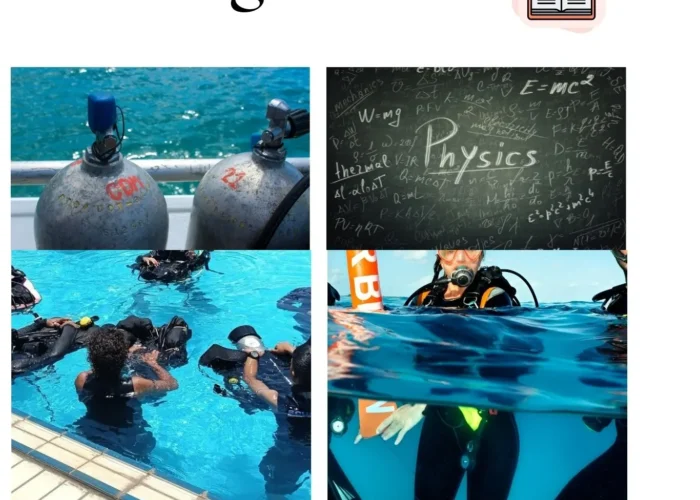
Many divers wonder why their scuba tank pressure drops in cold water. The amount of change in either volume or pressure of a given volume is proportional to temperature changes. At Diving Mentor, we want you to understand how this affects your gear and your safety underwater.
As the temperature increases, the volume of a flexible container will increase, and the pressure inside a non-flexible container (like your scuba tank) will increase. Conversely, as the temperature decreases, the volume of a flexible container will decrease, and the pressure inside your scuba tank will decrease.
The 0.6 Bar Rule: Why Scuba Tank Pressure Drops in Cold Water
FOR EVERY 1 DEGREE CELCIUS CHANGE IN TEMPERATURE, THERE IS A 0.6 BAR CHANGE IN PRESSURE.
Example: If a tank is 200 Bar in the sun (40°C), and you jump into 20°C water:
Answer: 200 – (20 * .6) = 188 Bar.
More heat equals more volume or more pressure because air molecules move faster. Less heat means molecules stay closer together, causing less pressure. As a Diving Mentor student, grasping these diving physics principles makes you a more competent and safer diver.
Charles’ Law combined with Boyle’s Law
Understanding the physics of gas as taught in PADI courses is essential for safety. These laws explain the math behind the pressure changes:
P1 V1 / T1 = P2 V2 / T2Test Example: A gas occupies 20L (V1) at 5 atm (P1) and 500K (T1). What will the volume (V2) be if the pressure is raised to 10 atm (P2) and temperature is changed to 250K (T2)?
Answer from Diving Mentor: V2 = 5 L.
Real-World Application
In the real world, this affects you most on a sunny boat. You fill your tanks, your students check them (Remember BWRAF), and then they complain about losing 10 bar after jumping into cold water. Understanding that scuba tank pressure drops in cold water is a vital skill we focus on during our beginner diving training in the Red Sea.
Diving Mentor always recommends a quick air check after the descent. You will be amazed how much air some people use at the start of their dives just trying to descend!
Master Your Diving Journey
Ready to go deeper? Enhance your skills with our specialized courses:
PADI Deep Diver Specialty | Enriched Air Nitrox
Do you have more questions? Our team is ready to guide you.
Common Questions About Tank Pressure
Why did my scuba tank lose 10 bar after jumping in the water?
This is caused by Charles’ Law. When the warm air inside your tank is cooled by the water, the pressure drops. On average, you lose about 0.6 bar for every 1°C drop in temperature.
What is the 0.6 bar rule in diving?
The 0.6 bar rule is a Diving Mentor guideline stating that for every 1 degree Celsius change in temperature, there is a corresponding 0.6 bar change in tank pressure. This helps divers predict pressure changes between the surface and depth.
Does temperature affect air consumption?
Directly, no, but indirectly yes. Cold water can cause your body to use more energy to stay warm, which increases your breathing rate. Understanding diving physics at Diving Mentor helps you manage your air more efficiently.
Can a scuba tank explode in the sun?
While rare due to safety burst disks, high heat significantly increases internal pressure. Diving Mentor recommends keeping tanks in the shade to avoid unnecessary stress on the valve and O-rings.