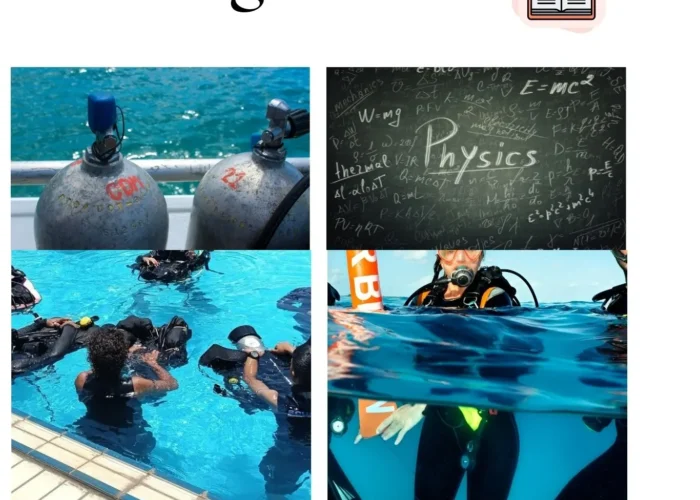
Understanding the physical laws governing gas behavior underwater is the cornerstone of diver safety and professionalism. Furthermore, principal among these is Boyle’s Law which defines the inverse relationship between pressure and volume—a principle that explains the physiological and mechanical changes occurring during every scuba dive.
The Scientific Foundation: What is Boyle’s Law?
Boyle’s Law states that, at a constant temperature, the volume of a gas is inversely proportional to the pressure exerted upon it
Mathematically, this is expressed as:
P₁ × V₁ = P₂ × V₂
This equation dictates that any increase in underwater pressure results in a proportional decrease in gas volume, and vice versa. To apply this, we must understand the two types of pressure acting on a diver:
- Atmospheric Pressure: Constant at 1 bar at sea level.
- Hydrostatic Pressure: Increases by 1 bar for every 10 meters (33 feet) of depth in saltwater.
Practical Example: Gas Expansion During Ascent
Consider a flexible container, such as a balloon or even a diver’s lungs, holding 22 liters of gas at a depth of 27 meters:
- Calculating Depth Pressure: At 27 meters, the ambient pressure is 3.7 bar (1 bar atmosphere + 2.7 bar water pressure).
- The Result: As you ascend to the surface, Consequently, the volume expands by a factor of 3.7, reaching a staggering 81.4 liters.
This significant expansion is why we focus so heavily on buoyancy control in our PADI Open Water Course. It also explains the “Golden Rule” of scuba diving: “Never hold your breath”.
💡 Mentor Tip: The Density Factor
“Moreover, Boyle’s Law doesn’t just change volume.; it changes density. At 27 meters (3.7 bar), every breath you take contains 3.7 times more molecules than at the surface. This is why your air consumption increases with depth and why mastering your breathing is critical for longer, safer dives.”
Watch & Learn: Visualizing Boyle’s Law
To better understand how these pressure changes affect you underwater, watch this visual explanation from the Diving Mentor YouTube channel:
Learn how pressure and volume change during your dive.“Learn the fundamentals of Dive Physics and why understanding pressure and volume is essential for every diver.”
Frequently Asked Questions about Boyle’s Law
According to Boyle’s Law, it explains how air inside your lungs and equipment compresses and expands. Understanding this is vital for preventing lung over-expansion injuries and barotrauma
The golden rule is “Never hold your breath.” As you ascend, pressure decreases and the air in your lungs expands. Consequently, holding your breath can cause the expanding air to rupture lung tissues.
As you go deeper, the air you breathe becomes denser. Therefore, you consume more air from your tank with every breath at depth compared to the surface.
Yes! It affects your BCD and your wetsuit. As you descend, the air trapped in your suit and BCD compresses, making you less buoyant. This is a key topic we cover in depth during our Advanced Open Water training.