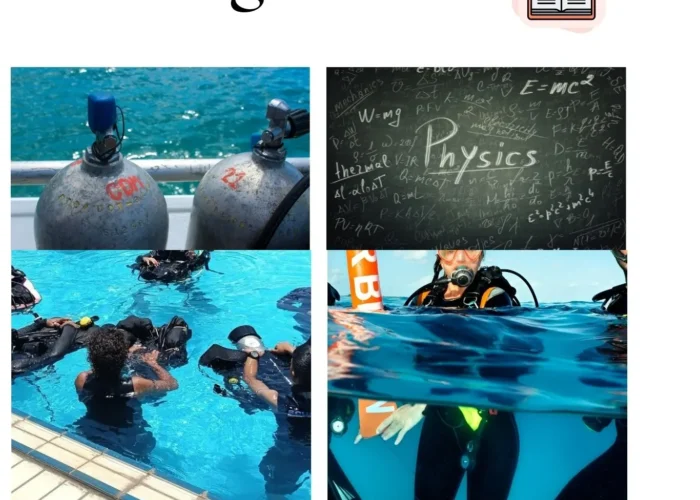
The amount of change in either volume or pressure of a given volume is proportional to temperature changes. At Diving Mentor, we want you to understand how this affects your gear. As the temperature increases, the volume of a flexible container will increase, and the pressure inside a non-flexible container (like your scuba tank) will increase. If the container is flexible, the pressure will remain constant.
The opposite happens when the temperature decreases. As the temperature gets less, the volume of a flexible container will decrease, and the pressure inside your scuba tank will decrease. In this case, flexible containers’ pressure will remain constant.
The 0.6 Bar Rule
FOR EVERY 1 DEGREE CELCIUS CHANGE (up or down) IN TEMPERATURE THERE IS A 0.6 BAR CHANGE IN PRESSURE.
Example: If a tank is 200 Bar and on the boat in the sun at 40 Degrees Celsius, what pressure would the tank be if someone puts the tank on and jumps in the water which is 20 Degrees Celsius? Answer: 200 – ( 20 * .6) = 188 Bar.
- More heat = more volume / more Pressure. Air molecules move fast because it’s so hot causing more pressure.
- Less heat = less volume / less Pressure. Air molecules stay closer together causing less pressure.
This level of understanding is normally not required, but as a Diving Mentor student, it’s all the better if you can grasp this. In general, just remember the 0.6 bar rule. If a gas temperature rises and the volume stays constant, pressure increases. If temperature rises and the pressure stays constant, volume increases
Charles Law combined with Boyle’s Law
P1 V1 / T1 = P2 V2 / T2
Test Example: A gas occupies 20L (V1) at 5 atm (P1) and 500K (T1). What will the volume (V2) be if the pressure is raised to 10 atm (P2) and temperature is changed to 250K (T2)? Answer from Diving Mentor: V2 = 5 L.
Will this ever affect me in the real world?
In the real world, this affects you most on a sunny boat. You fill your tanks, your students check them (Remember BWRAF), and then they complain about losing 10 bar after jumping into cold water. Diving Mentor always recommends a quick air check after the descent to stay aware. You will be amazed how much air some people use at the start of their dives just trying to descend!